Hyperopia & Presbyopia Exercises
Hyperopia Theory
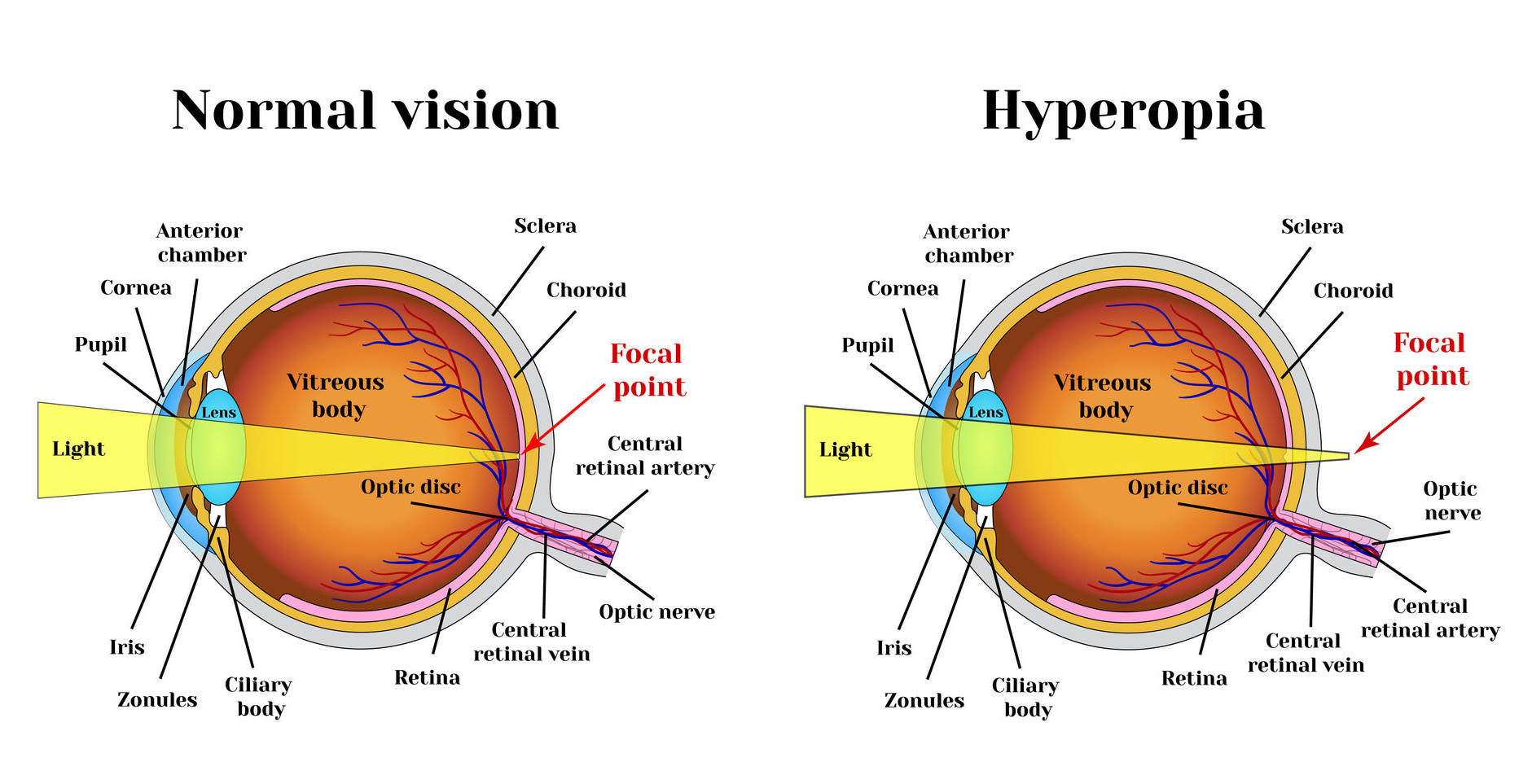
Another common refractive error is hyperopia (also known as farsightedness). It is often described as the opposite of nearsightedness — distance vision is relatively clear, but close-up vision is blurry. This can cause eye fatigue when reading and can lead to headaches and eye irritation. Hyperopia is often related to the structure of the eye: the eye is either too short or its cornea is too flat. As a result, the light rays entering the eye are focused behind the retina rather than on it.
Presbyopia Theory
Presbyopia, or age-related farsightedness, is — as the name suggests — a natural age-related change in the eye's focusing ability. It commonly appears in people over the age of 40. It often progresses into the 60s and may then stabilize. The symptoms are the same as in hyperopia: difficulty seeing objects close to the eyes clearly. However, the underlying cause of presbyopia is different from the farsightedness discussed above.
That said, the experience of age-related near-vision changes varies from person to person, and some older people report needing glasses very little. The lens does become less flexible with age, and Bates Method practitioners also focus on the role of eye-muscle tension; the techniques of Dr. Bates' Method are presented here as self-care practices that may help some people develop more comfortable reading habits.
For presbyopia, the same exercises used for hyperopia are presented below.
Exercise D1. Reading Text in Various Sizes
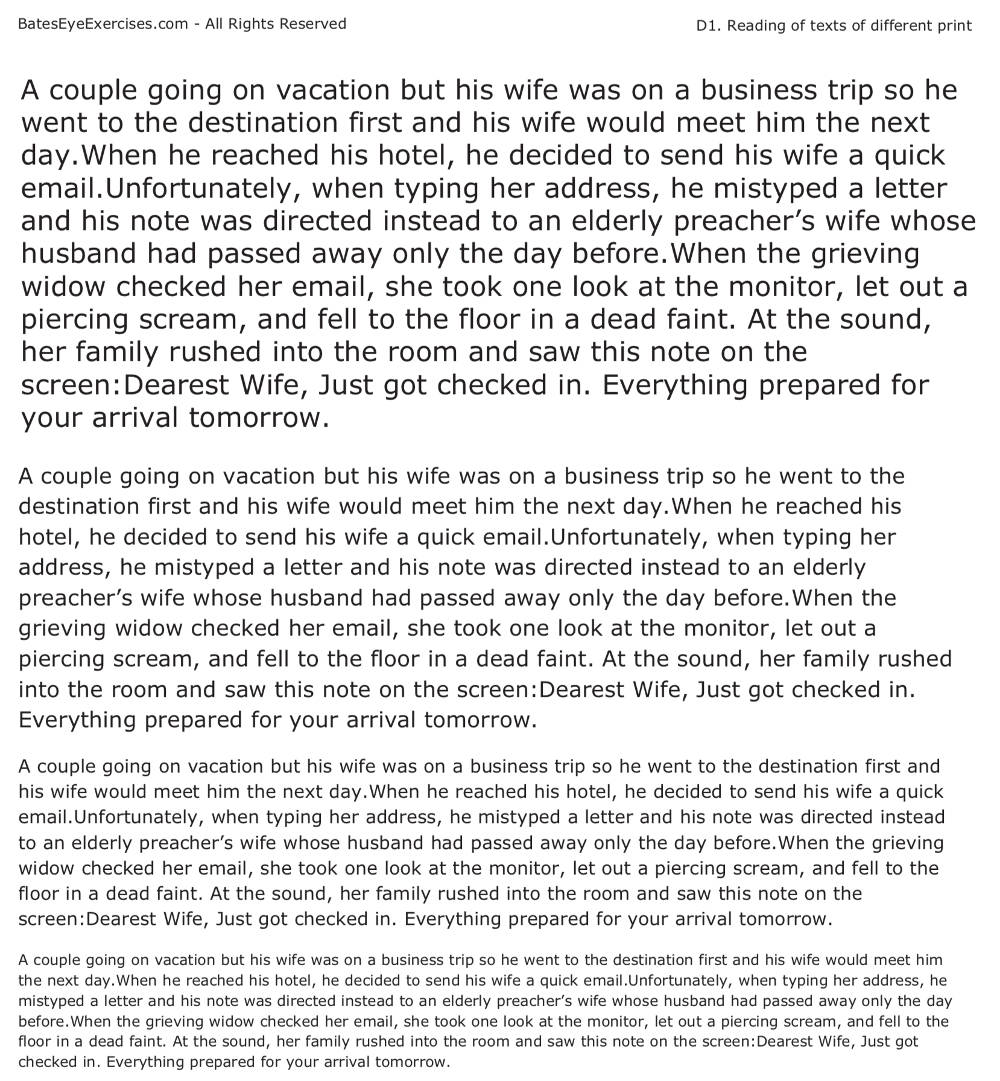
For people with farsightedness, reading small print with relaxed eyes is one of the main Bates Method practices for near vision. Text printed in a range of font sizes helps you practice focusing on smaller and smaller letters while maintaining dynamic relaxation.
- Place the chart at a distance so that the largest letters are slightly blurred but easily recognizable.
- Start by looking at the large print, letter by letter. Let your eyes wander around the letters and their shapes, imagining in your mind how black they are. Blink frequently, and every now and then close your eyes and visualize what you just read.
- Now move on to the smaller print and repeat step 2. If you can no longer make out the letters clearly, simply observe whatever you see, however strange or blurred. Do not strain your eyes; just look at the contours, edges, and spaces between the letters and words. Blink to keep your vision relaxed. Every now and then, close your eyes and repeat in your mind: "the page is white, and the letters are black."
- If your eyes are not too tired, repeat step 3 with even smaller text.
- Now return to the larger print. You may find it clearer and larger than at the beginning of the exercise.
Exercise D2. Reading Inverted Text
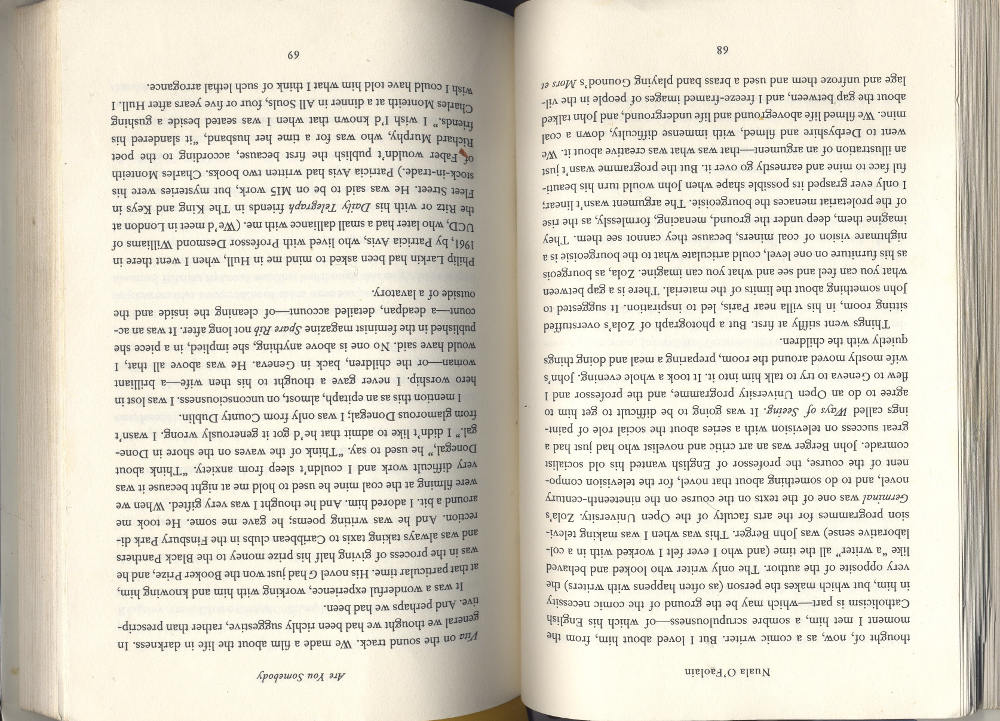
The inverted-text exercise helps you focus on what your eyes actually see, without automatically reading the words.
- Turn a page of any book 180 degrees and set it at a distance so that the text is slightly blurred.
- Read each letter individually, letting your gaze move point by point, gradually and carefully following the shape of the letter. Try to blink often and breathe freely. If it helps, you can imagine a small black dot that you move along the shape of each letter. Do not try to recognize letters or words, just freely move your gaze over the letters. At the end of each line, close your eyes for a moment and visualize the blackness of the letters.
Exercise D3. Reading with Tromboning
This exercise is intended to help you practice your near point of clear vision and may make close reading feel more comfortable over time.
- Place a book or chart with text in different sizes at a distance where you can easily read the text.
- Slowly bring the sheet closer to your eyes until you can no longer read the text.
- When the print becomes blurry, move your gaze along the letters and words without trying to recognize them. Don't strain your eyes, just focus on the contours, edges, and spaces between the letters and words. Blink to keep your vision relaxed.
- Now move the sheet away from your eyes until you can read the text again.
- Repeat steps 2 and 3 several times.
- If you are using a chart, you can repeat the exercise with smaller text.
- Check whether you can now read comfortably at a shorter distance than before.
Exercise D4. Exercise with Two Charts
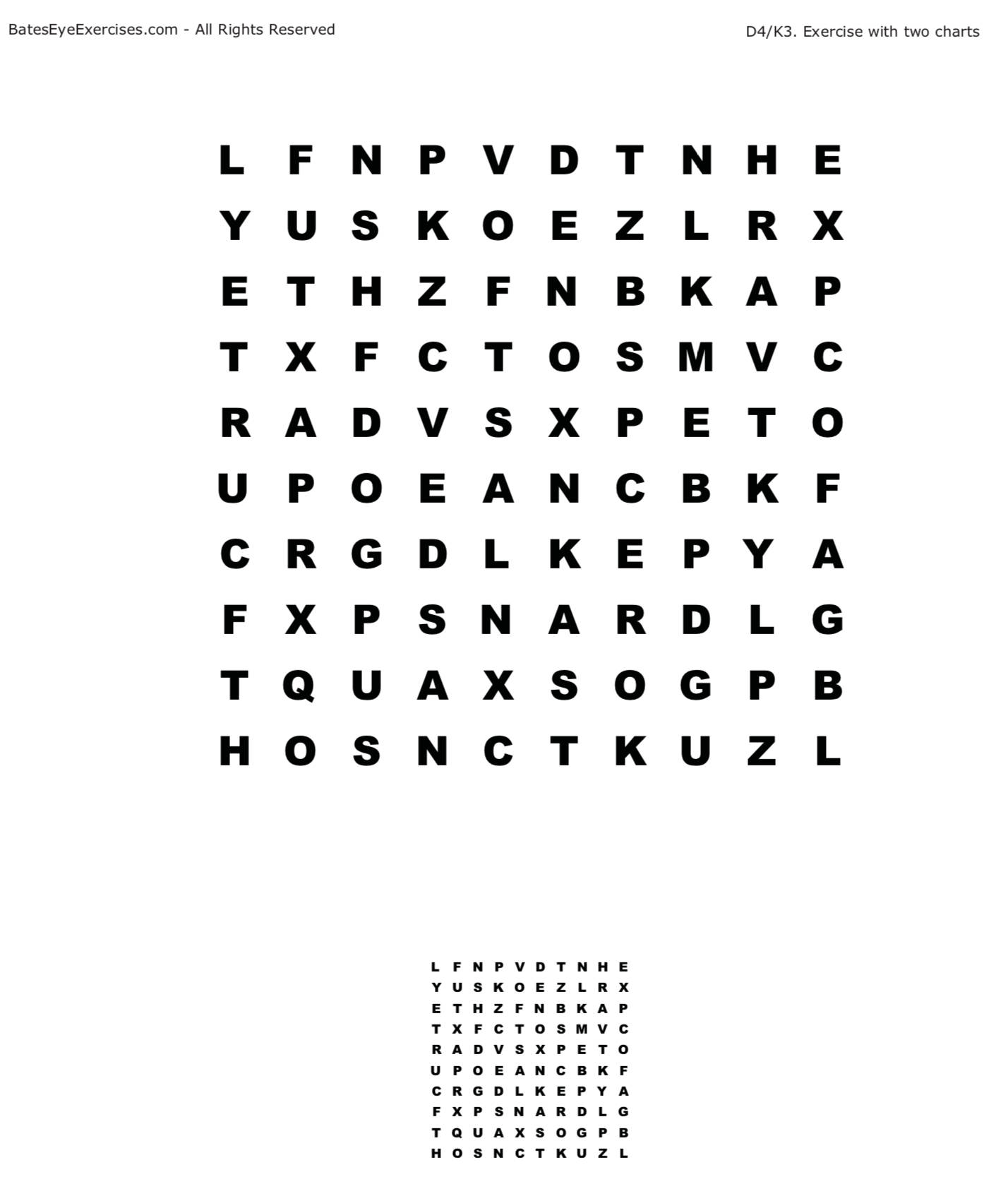
This exercise allows you to practice alternating between near and far vision, with the goal of supporting accommodation and depth perception.
- For this exercise, you will need a special chart with letters for viewing at both near and far distances.
- Attach the large chart to the wall at a distance where you can see it clearly, and hold the small chart in your hand at a distance where the text is visible but slightly blurry.
- Read 3 consecutive letters on the large chart, close your eyes for a second and visualize those 3 letters, then look at the small chart and read the same letters. Do the same with the next 3 letters.
Primary source: W. H. Bates, Perfect Sight Without Glasses (1920), ch. 20 and 9 — full text at Wikisource.